
Size the sauna heater for the room—not the person-count label.
A “four-person” cabin does not identify its heating load. Measure the enclosed interior, account for its construction using the manufacturer’s method, and check the specific heater’s permitted room range.
Start with the package if you are buying a kit. Ask which heater models the cabin manufacturer supports before substituting a larger or smaller unit. If you are planning a custom room, assemble the room information first. Neither path ends with a universal “one kilowatt per X cubic feet” answer.
Three quantities to keep separate
A worked example using Harvia’s documented surface adjustment
Harvia’s support guidance adds 1.2 m³ of equivalent room volume for each 1 m² of glass, stone or similar uninsulated surface. It separately identifies a factor of 1.5 for uninsulated log interiors. These are Harvia planning instructions, not a formula to apply to every brand or to combine arbitrarily.
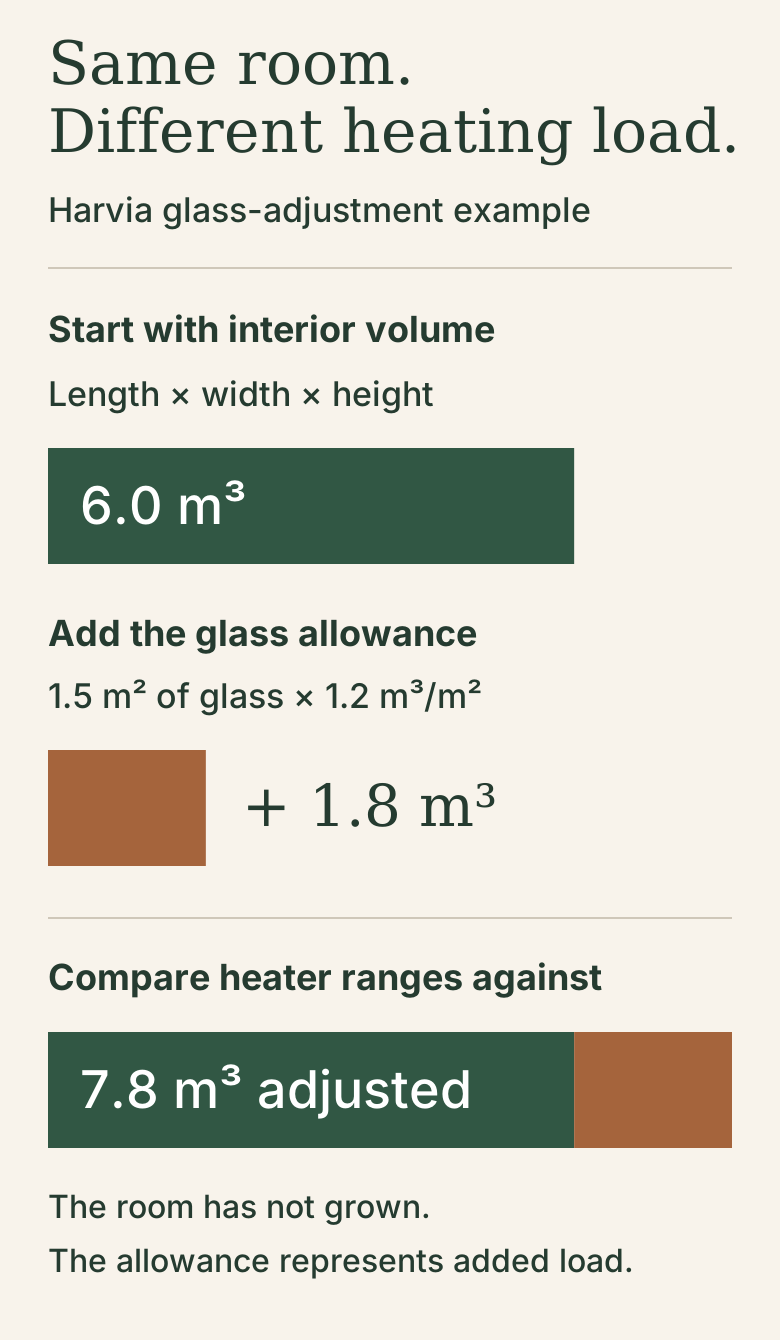
Illustrative rectangular room—not a product recommendation
Interior: 2.0 m × 1.5 m × 2.0 m = 6.0 m³ (about 212 cuft).
Documented uninsulated glass in this example: 1.5 m².
Surface adjustment: 1.5 × 1.2 = 1.8 m³.
Adjusted planning volume: 6.0 + 1.8 = 7.8 m³ (about 275 cuft).
Assumption: this worked example uses the glass adjustment only; it is not an uninsulated-log room. Confirm the applicable method for the real construction with the manufacturer.
The result is not “buy a 7.8 kW heater.” It is a volume to compare with the relevant model range. Harvia’s guidance recommends considering where the calculated volume lies within that range, not simply choosing a unit whose maximum barely covers the room.
Match the exact U.S. model—not a similar name from another market
Harvia’s U.S. 2024 catalog lists the KIP60B, product JH60B2401, at 6.0 kW and 240 VAC single-phase 60 Hz, with a stated sauna-volume range of 170–300 cuft (4.8–8.5 m³). The illustrative 7.8 m³ result falls inside that documented range, toward its upper end. Confirm the selection against your construction and the current model instructions before ordering.
Check the current model and manual before ordering. A matching “6 kW” description does not prove that controls, voltage, regional approvals, clearances or installation requirements are the same. Ask the supplier to reconcile any difference between a current listing and an older catalog.
What this means when comparing actual sauna kits
The Almost Heaven Salem configuration includes a specified 6 kW KIP option in the manufacturer listing. A barrel is not a rectangular box: multiplying its maximum width, length and height does not give its actual cylindrical interior volume. Ask the cabin manufacturer to confirm the supported heating package rather than using an oversized rectangular envelope to justify a replacement heater.
The SaunaLife CL4G is a different glass-fronted cabin. Obtain its interior geometry, glass information and compatible heater specification before selecting a seller’s heater bundle. A cabin price without those package details is not a complete heater recommendation. Read the CL4G model manual alongside the proposed heater manual.
Use a “confirmed / missing / outside range” worksheet
- Room: exact interior dimensions and shape. If a curved ceiling or barrel shape is involved, obtain the correct volume or calculation method.
- Construction: insulation, wall/ceiling construction, glazing and other relevant surfaces. Mark every unknown explicitly.
- Method: current manufacturer instructions, applicable adjustment and resulting planning volume. Do not add conflicting rules from different brands.
- Heater: exact U.S. model code, current permitted room range, controls and required installation documentation.
- Decision: inside the documented range means further checks; outside means revise the shortlist; missing essential data means no sizing conclusion yet.
Capacity is only one gate. Clearances, bench layout, ventilation, mounting, electrical supply and control/sensor requirements also need to be satisfied under the exact instructions.
Which purchase path should you choose?
For a complete kit: prioritize a manufacturer-supported cabin/heater combination with a clear installed scope. Use the Salem and CL4G product records to identify what is included and which documents are still needed—not to assume interchangeability.
For a custom room: have the supplier or qualified designer confirm the adjusted volume and exact heater range from the construction details. If the result sits near a limit or key surfaces are unknown, ask for a documented recommendation before purchasing. “Bigger to be safe” is not a substitute for a supported selection.
Next check heater-package contents, electrical purchase fit and room and access planning. Use the per-session running-cost calculator to keep rated kW separate from energy consumed.