
120V vs. 240V home saunas: choose the model, then check the power.
A familiar-looking outlet is not a purchase decision. Start with the exact U.S. sauna, its heating package and its accessories; then find out what your home can support.
The short answer: some compact infrared cabins use 120V, while other infrared models and many traditional electric packages require 240V. Neither voltage is a quality score, a guarantee of faster heating, or permission to use an existing circuit. Choose the experience and usable space you need first; confirm the electrical fit before paying a deposit.
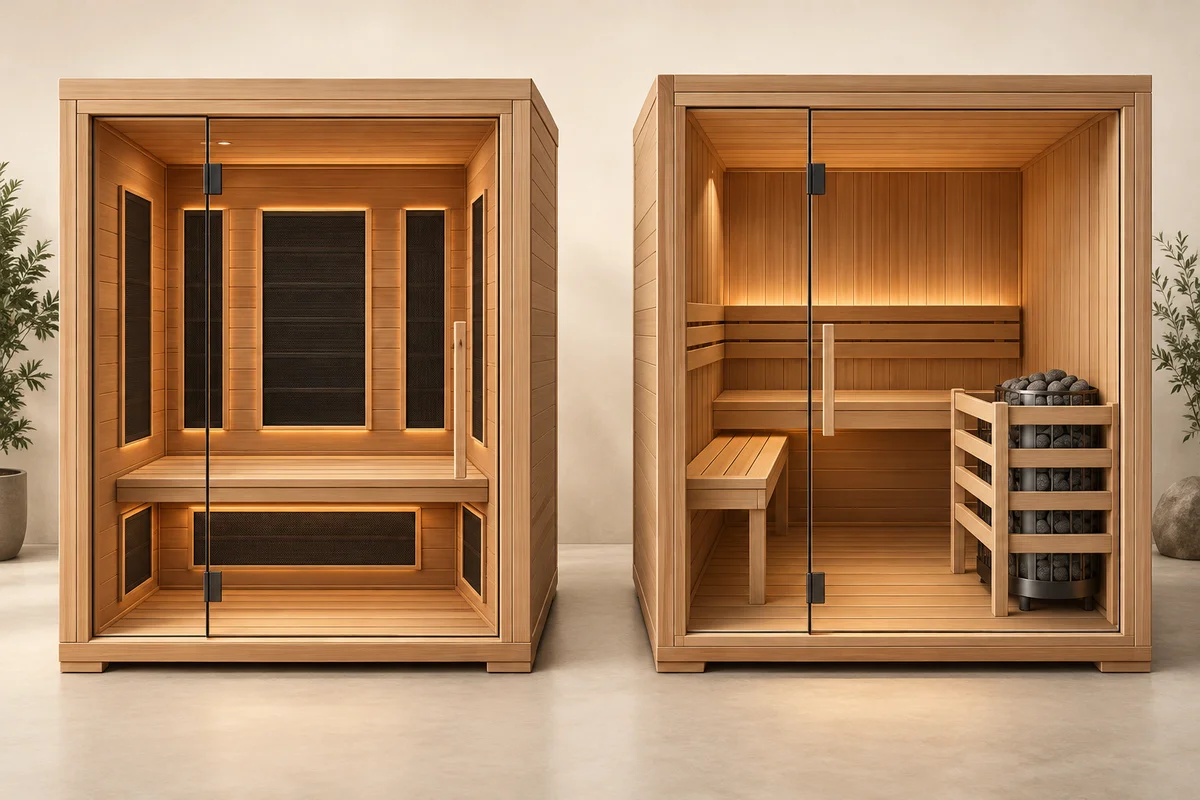
Three examples that break the simple 120V/240V rule
Compare the exact heater and accessories before getting an electrical quote. Changing the configuration may change the requirements.
PEAK Mini: compact, indoor and 120V
The Mini’s U.S. listing specifies 120V, 10A and 1,200W, with a NEMA 5-15P plug. The 2026 v3 manual identifies a matching grounded NEMA 5-15R receptacle. Here, 10A describes the appliance’s full-load amperage; it is not a direction to install a 10A breaker.
Compare the PEAK Mini catalog page if a one-person indoor cabin is your target. “Plug-in” still leaves the condition, location and suitability of the supply to be checked.
Clearlight Sanctuary: infrared does not mean 120V
Clearlight lists the Sanctuary 2 at 120V/20A, but the Sanctuary 3 at 240V/15A. Its Sanctuary 2 listing changes to 120V/30A with the specified additional heater or red-light upgrade. That is why the accessory list belongs in the quote, not in an afterthought.
The accessory package can matter as much as the cabin size.
Almost Heaven Salem: heater and lighting are separate
The selected Salem page identifies a 6kW KIP heater with dials and lists 240V, a 30A requirement and a hardwired connection. It separately lists plug-in lighting with 110V/15A service. A heater-only quote would miss that second requirement.
Inspect the Salem configuration and ask for the exact heater manual with your final order. A cabin assembly manual is not a substitute for the heater’s electrical instructions.
Read four different things—not just “120” or “240”
Do not turn a watts-divided-by-volts calculation into a wiring plan. Your electrician needs the actual nameplate and current installation manual to assess the circuit, protection, routing and local requirements. The presence of a spare breaker space—or another 240V appliance elsewhere in the house—does not establish capacity for this sauna.
When “plug-in” still deserves a pause
A plug-in cabin can narrow the installation scope, but cannot tell you whether the chosen location works. For the Mini specifically, the manual prohibits extension cords, power strips and adapters, and identifies a GFCI compatibility limitation. Resolve that limitation before purchase; never remove required protection to make a sauna work.
If a product instruction appears to conflict with protection required at your proposed location, stop and ask the manufacturer and a qualified electrician to resolve the issue under the applicable requirements. Do not bypass a protective device, replace it yourself, or choose a different room simply because an online guide says a socket will work.
For a rental, obtain the necessary property permission before committing to work. For an outdoor position, include exposure, the proposed route from the home and the location of every powered component in the assessment.
Send this one-page brief before asking “what will installation cost?”
- The exact order: manufacturer, U.S. model/SKU, selected heater, controls, lighting and every powered upgrade. Attach the quote, not only a family-level product link.
- The documents: current cabin and heater manuals, electrical specification sheet, and nameplate information if available. Flag anything still missing.
- The proposed location: indoor/outdoor, a simple location sketch, approximate distance to the supply, and any walls or finished surfaces along the likely route. Let the electrician determine the route.
- The site assessment: ask whether the supply and panel can support the specified equipment, what protection and connection are required, and whether permits or inspection apply. Do not open electrical equipment to collect information.
- A separated price: assessment, circuit work, any panel work, access/trenching or finish repairs, permits/inspection, and connection of heater versus accessories. Unquoted items stay unknown—not $0.
- The purchase gate: request a written scope with assumptions and exclusions, and confirm which model changes would require a new quote.
Copy those headings into your notes. You should finish with either a documented installation scope or a specific unanswered question—not merely “the electrician said 240V is possible.” The project budget worksheet helps keep the cabin price separate from the site costs.
Which option belongs on your shortlist?
- One-person indoor use with limited appetite for building work: investigate a documented compact plug-in model such as the Mini. Keep it only if the actual location and supply meet its current instructions and applicable requirements.
- A traditional stone-heater experience: compare a complete specified package such as the Salem, with both heater and accessory power included in the installation scope. Do not select it on the “240V” label alone.
- More space or upgraded infrared equipment: make a new electrical check for that exact model and accessory combination. Do not carry over the smaller cabin’s quote.
- Unknown supply, conflicting instructions or an unpriced upgrade: hold the order until the relevant professional or manufacturer resolves it. Changing the sauna shortlist may be more practical than changing the home.
Next, check the space and delivery route, confirm what the heating package actually includes, and complete the installation checklist. If you have not chosen a heat type yet, start with our traditional-versus-infrared buying comparison.