
Calculate your sauna’s electricity cost—one session at a time.
A 6kW rating is not a 6kWh bill. Electricity cost depends on how long the heater runs, how much it cycles after warm-up and what you actually pay per kilowatt-hour.
Use your own tariff. This calculator deliberately leaves it blank. Enter the variable energy charge relevant to the time you will use the sauna, including applicable per-kWh delivery charges. It does not predict fixed utility fees, demand charges or taxes not included in your rate.
Build a transparent cost scenario
The default power and timings below are an editable illustration, not a prediction for any cabin. Warm-up assumes full rated power throughout. The selected session duty cycle means the share of session time spent at full power; 50% is a scenario, not a measured universal average.
Enter your tariff and calculate. No estimate is shown until every input is supplied.
A worked example you can audit
Assume a 6kW heater, 30 minutes of full-power warm-up, then a 30-minute session at a 50% duty cycle. Use an illustrative $0.20/kWh tariff—not a U.S. average.
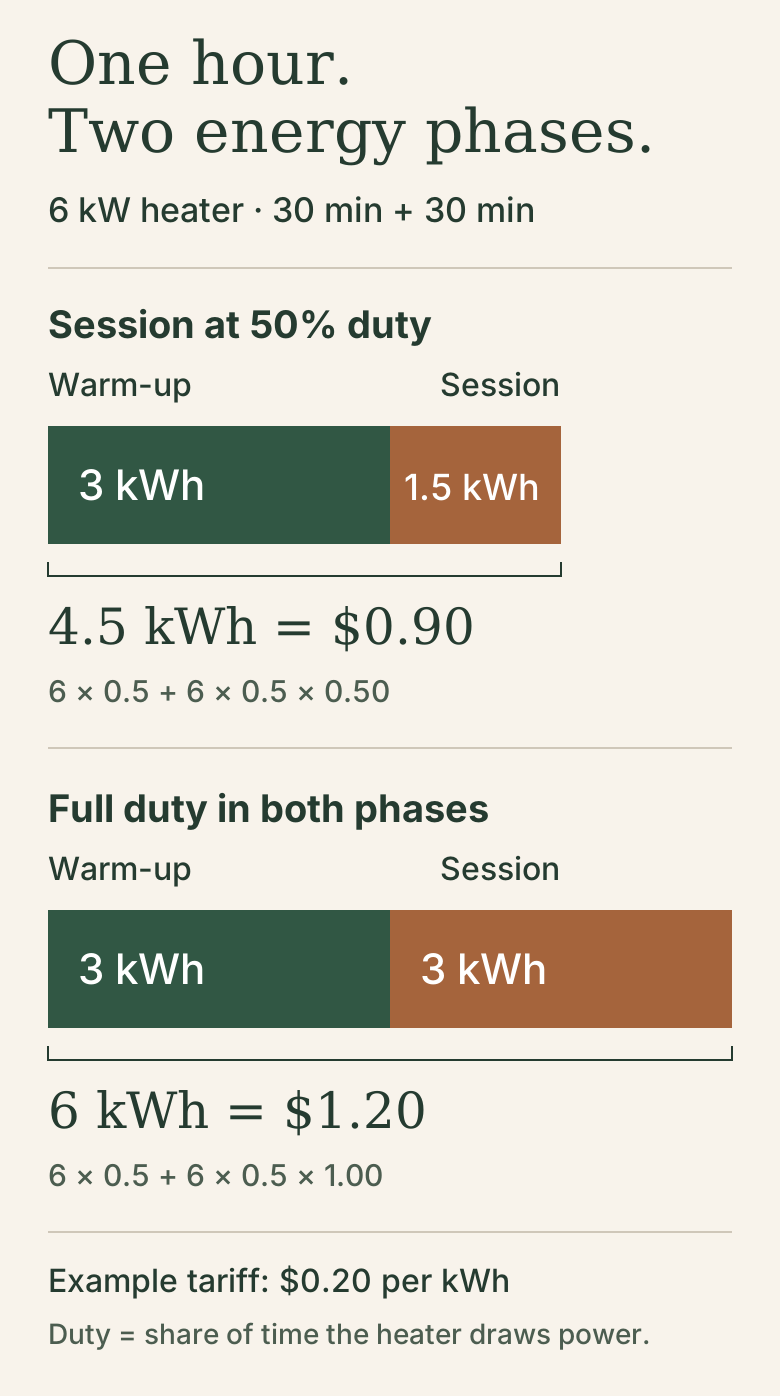
- Warm-up: 6 × (30 ÷ 60) = 3 kWh.
- Session: 6 × (30 ÷ 60) × 0.50 = 1.5 kWh.
- Total: 4.5 kWh × $0.20 = $0.90 per session.
- Twelve separate sessions: 12 × $0.90 = $10.80 for the modeled heater energy.
At a 100% session duty cycle, the same timings become 6kWh and $1.20 per session. This is a full-power reference for the specified heater and time—not an upper bound on a bill that also includes other equipment or longer use.
The formula, with the assumptions exposed
Session energy (kWh) = rated kW × [warm-up minutes/60 + session minutes/60 × duty fraction]. Then multiply by your USD/kWh tariff. Monthly modeled cost is per-session cost × the number of sessions.
Harvia explains that thermostatic control changes element operation after warm-up, and its illustrative consumption figures depend on room construction and use. We use that principle, not the article’s sample household bill or tariff, to distinguish warm-up from the later session.
Your actual warm-up may include cycling, and your session may need a higher or lower duty cycle. Outdoor conditions, room materials, target temperature, door opening and the selected heater all matter. If you have trustworthy measured energy from equipment designed for the installation, use it to refine assumptions. Do not attach a household plug meter to hardwired or incompatible equipment.
Choose a documented input—not a headline cost claim
The selected Almost Heaven Salem package lists a 6kW heater, making it a concrete source for the calculator’s power input. That does not establish its warm-up time or duty cycle at your site. Its separately powered lighting is outside a heater-only calculation.
The PEAK Mini listing specifies 1,200W, or 1.2kW. You can explore a scenario with that power, but do not copy the traditional sauna’s cycling or timings and call it a measured infrared cost. Confirm whether the stated input covers the particular accessory configuration you will operate.
Lower rated power alone does not establish a cheaper equivalent experience: the cabin size, heat type, time and user expectations may differ. Compare suitable purchase options first, then apply consistent, clearly stated cost assumptions.
What the result leaves out
- Upfront work: cabin, heater purchase, delivery, foundation and electrical installation. Use the separate project budget worksheet.
- Other energy: lights, controls, additional heaters or accessories not already included in the power input.
- Tariff complexity: time-of-use changes, tier boundaries and charges not included in the entered rate. Run separate scenarios where rates differ.
- Other ownership costs: maintenance, replacement parts and repairs. These are not electricity.
Use the estimate to make a better purchase
If electricity cost is a deciding factor, ask the seller for documented input power and any credible model-specific consumption evidence, including test conditions. Run at least two realistic duration/duty scenarios with your tariff. A narrow range based on guessed assumptions is less useful than a clearly labeled uncertainty.
If a lower-power cabin already meets your space and heat preferences, compare it with a higher-power option using suitable timings—not equal kW labels. If it does not meet those needs, an attractive modeled running cost is not a reason to buy the wrong sauna.
Before ordering, finish the electrical-fit guide, check included heating equipment, and compare traditional versus infrared on the experience and installation scope you actually want.